Friday, 23 June 2017

Task 2A Audience Theories

Passive and Active Consumption; 


Passive consumption is a unresponsive reaction to a text in the media. A good example of a text this works with is Hollyoaks and other soap operas. This is because these shows are prerecorded and so therefore the audience watching can do nothing to change it. This means that the audience can still react to what is being shown but can not actively change the outcome, so no active consumption is occurring
Active consumption is when the audience can change the outcome of what happens in the Show. For example on Britain's got talent the public can vote on who they want to stay and then finally who they want to win the show. This means they are having an impact on the outcome of the show. This type of consumption usually takes place on live television shows where it is easy for the audience to phone or text in or even sometimes use an app to vote for their favorite act. This is what differs from passive consumption as the audience are actually making an impact on the show as it is being shown. Other shows like this include X Factor, Love Island and The Voice.


Hypodermic Needle Theory; 
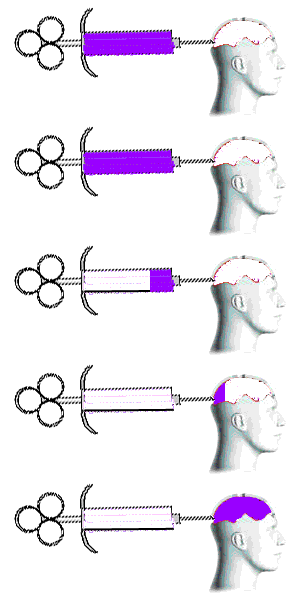
Hypodermic needle theory is the theory that when watching media like at the cinema we just absorb what we see and can't control what happens. This means that the media has control of us because we can only watch it, this makes the audience passive. An example of this is films in the cinema, you have to watch it and just absorb it because you cant do anything to change what is going to happen. 


Cultivation Model; 


Two Step Flow Model - How these influence the Effects Debate (sex/violence/censorship);


Use and Gratifications Theory; 


Reception Study; 
(include responses, negotiated, preferred, oppositional, participatory) 

Reception study is divided in four parts. The dominant part of reception theory is about what the audience like and agree with. This could be related to people in power during election periods like telling the audience what they want to hear so that they get more votes and get into a higher position of power.
Opposed views are when the majority of the audience knows what the dominant view is but doesn't like the dominant view, these peoples opinion do not often change from being opposed and they actively reject what they see on the media.
The negotiated view is used when the audience is unsure. Negotiated could be related to the news, as there is often people who disagree about stuff that is talked about on news. This links to news channels that can be biased towards one point and so there will be disagreement from their audience. 
Participatory view has audience participation which means the audience will make a decision about who they think is right from what they have seen.The audiences decision will change their opinion and view of the media, their decision can be influenced by others. Media that makes a participatory view will include the audience's participation unlike the Hypodermic needle model which does not have any choice.
The preferred response is what the audience's message will be from the media, this message comes from the producer. For example in horror films there is a villain who will attack the victims, throughout the film the villain hero will show a reason to be angry and scary and this is what the producer wanted because they want to scare the audience.

Friday, 10 February 2017

Task 3- Fairy Liquid Adverts

 Analysing Fairy Liquid adverts   

1960's Fairy liquid advert
In this advert we can quite clearly see that there is a mother and a daughter at home doing the washing up. The mother is explaining to the daughter what the product is and this is a good way to explain it to those viewing the advert as well. Another reason as to why she might be explaining it to the daughter is because she is preparing her for later life as in those days it is what the woman would do. This is evident by the fact that we see no Father figure in the picture as we assume he is out working. At the start of the advert we see the daughter playing with alphabet blocks, we can clearly see these are labeled "F" and "L" which relates back the product name "Fairy Liquid", which is very clever and a good way of promoting the product.  The mother is the main character in the advert which is evident as the camera shots are mainly focused on her, however the daughter is also seen a lot but she is not considered the main character, this advert is what's known as a single strand advert. This advert has tried to introduce a second selling point other than the product itself and this is evident in the advert when the mother talks about soft hands, a lot of women in this generation were worried about how they looked and portrayed themselves to the men of this era. therefore giving them soft hands when using the product is an effective way to sell the product, as in this time it would be predominantly woman who would use the product.

1970's Fairy Liquid advert
In this advert we again see that they have used a mother and a daughter as the predominant characters in the advert. In this advert we see the daughter outside watering the plants while her mother is again washing the dishes. This could mean a number of things for example it could be showing that the daughter is growing up and is starting to do chores that a mother would usually do so is preparing herself for later life as a housewife which was very common in this time. However it could also suggest that fairy liquid are trying to get across the point that they want their product to smell like flowers which is again a selling point for women as most women all love flowers. We see a close up of the mothers hands after she has used the fairy liquid which to me again is saying like in the previous advert that fairy liquid provides woman with soft skin, so we can see that they have stuck with the same unique selling point.        

1980's Fairy Liquid Advert   
In this advert we quite clearly see a big difference to the previous adverts as the female character is no longer at home but in a school. However this advert feels more personal because the female character is talking directly to the audience, which will engage the audience and make them more likely to want to buy the product, the advert shows fairy liquid being compared to other washing up products but is shown the be the superior one. Which will then hopefully convince the audience to buy their product. Comparing the fairy liquid product to the others in the advert we can clearly see that the fairy liquid bottle lasted longer which to me could mean a change in the unique selling point of the product, as it would be much more appealing to people as they would be saving money if they buy this product, it also shows that it produces a much better quality of cleanliness for the finished product, which again is very appealing to those viewing the advert.


1990's Fairy Liquid Advert
This is the fourth advert in a row where we still see no male character which means the roles that were expected of woman have still not changed. This advert follows the pattern of the previous advert I analyzed as again it is comparing itself to another washing up liquid. However this advert is a lot brighter than the previous adverts and is more colorful which could represent a change in the way women are perceived. Again this advert provides a close up of the mothers hand which is trying to sell the fact it leaves your hands soft when you use the product which proves that the company have stuck with the same unique selling point throughout the many years they have been on the market. The bond between the mother and the daughter could be a way of showing how happy fairy liquid makes its customers and that this is the reason why you should buy their product as it makes those who use it happy.


2000's Fairy liquid advert
Again the female character is present in the kitchen, however we have finally seen a change in characters as it is now the son who is with the mum in the kitchen. The mother is seen using the fairy liquid with the voiceover saying "a bit too long" which again is emphasizing how long the product lasts. Not only have we seen a change of character we have also seen a change of ethnicity to the previous adverts, this would be because they want to be considered inclusive and show that they are changing with the times. towards the end of the advert we see the mother pull out a frying pan which is very shiny and clean, which is a clever way of promoting the product as it is suggesting that this tiny drop of fairy liquid has cleaned the pan to that quality standard. which is again focusing on the selling point of long lasting effect and efficiency.


2015 Fairy Liquid Advert
This advert is quite different to the previous ones I have analyzed as we can see that there is a mother a father and a son present. The first thing we hear in the advert is "it's taking ages to run out" which is again focusing on the long lasting effect the bottle has and that its slowly become their man unique selling point as they are no longer focusing on the soft hands.  The mother is wearing green and white which is the colors of the fairy liquid bottle so they have been clever and used a slight bit of brand identity within the advert by making her wear this color clothing.  Having all 3 of these characters again shows that the fairy liquid company has changed with the times because nowadays not all mums stay at home on their own with children and they have pushed through the feeling of equality, which correctly represents todays society.

Tuesday, 7 February 2017

Task 3 Explaining the narrative theories

Vladimir Propp
Propp was a soviet formalist and he would analyze stories and simplify them into their narrative elements. It is said that he influenced Levi-Strauss and Roland Barthes with his work on morphology. He is used widely across the world as his character types can be used in any media platform. For example both in games and Television. Propp's theory was that stories would have an initial situation which would then allow the story to take the 31 functions. Propp suggested that characters could be broken up into 7 different categories, these were:
1) The Villain
2) The Hero
3) The Helper
4) The Princess
5) The Dispatcher
6) The False Hero
7) The Donor
Some of the roles above can be used by more than one character which is very common. There are some criticisms that come with Propp's theory, it is said that he has removed all verbal consideration from the way he analyses the stories.


Tzvetan Todorov
Todorov's theory suggest that all narratives follow a structure cut into three separate parts. It starts with the equilibrium, which is basically suggesting that everything is as you would expect it to be, we then discover the dis-equilibrium. This is where a problem occurs and changes the way we see the narrative. The third part of the structure is the attempt to repair the dis-equilibrium and then the return back to normality.


Levi Strauss

Levi Strauss is best know for modernizing anthropology. Strauss' main narrative theory was the idea of binary opposites for example a hero and a villain would be classed as binary opposites. Binary opposites reveal the structure of media texts. He's idea was that narratives oppose each other and can be put into pairs because of this. These opposites make the narrative move forward because they cause conflict which can establish the meaning of the film or narrative. He named these Binary opposites, and example of this would be Good VS Evil, I have included a picture with more examples of how this theory could work in a narrative structure.


Roland Barthes
Barthes was a French literary theorist and philosopher. Barthes had said that there was five codes that explained and explored the way a text means to those reading it. He believed that texts could be opened in many different ways but also closed as well. The five theory codes he believed in are as follows:
1) Enigma code
2) Action code
3) Semantic code
4) Symbolic code
5) Referential code
Barthes' theory is usually very good to use when opening a scene as you can use the Enigma code to create a mystery and engage the audience as they will want to find out more about the narrative. when you want to show the audience the real meaning of something and make it easy for them to identify what it is you are talking about you are most likely going to use the Semantic code.
                                                                                                            

Friday, 25 November 2016

Codes and Conventions of The Sun and The Times

The Times Newspaper and the Sun have very different readerships and this supported by the way the front covers of both magazines are produced. For example the Times uses a lot more text whereas the Sun focuses mainly on smaller text and more pictures.
Here we can see the Sun's front cover, and as I said before there is very little text and it is mainly made up of pictures of celebrities.  The sun tends to use less formal language to appeal to its target audience, which is again why there is very little text, this is because they are appealing to its target audience who are more likely to want to read their stories if they see photo's of people they are interested about. This means they use little text because it would be a waste of their time and would not grab their target audience's attention. The sun's stories are usually less formal as well and they do not cover what I would call hard news they mainly focus on soft news, but again they have to do this in order to appeal to their target audience.
Here we can see the front cover of the times newspaper which is very different to that of the Suns front cover. This has a lot more text and is the layout is very different. This is different because its demographic is A-C1 and this is what they like to see on the newspapers they read. It is also different to that of the suns because it focuses on hard news, For example the main image on the cover is of Hilary Clinton and the heading next to her is to do with politics. The font used in this newspaper is very formal and easy to read, this is because there is so much text that using a fancy font would make it difficult to read and therefore defeat the purpose of having so much text. The masthead of the Newspaper is very simple because it is not the main reason for the newspaper to sell, however it is effective because its is bold and you can really notice it when looking at the front cover.


To the left is a story I have chosen from the suns Newspaper, and as you can see there is again very little writing compared to that of a story which is produced in the times. The majority of the paper is filled up with a picture because that is what people would be most interested in. The language used is not very formal but this is what we would expect from the Sun as it has grown a reputation of being an informal newspaper. This is noticeable by the header "Kick up the Arsenal". There is very little room for text because of how big the key image is but this fits in with the readership and demographic of the target audience. You can grasp the story without even really reading any of the text because of just the heading and the photo, which is the case with most of the stories they sun provide.


As you can see to the right of this text I have chosen a story which is similar to the one from the Sun. We can clearly see that there is a lot more text than that of the Suns story, this is because those people who read this newspaper like to read into greater depth about the stories they are reading and do not focus predominantly on pictures to tell the story. As we can see the key image is still very big but they have surrounded it with text so it does not overpower the whole story. The times focuses mainly on the text in order to tell the story which is why there is so much of it, this is because it is what they believe works with their target audience.


Moodboards


My own design of front cover's of newspapers/magazines


Tuesday, 15 November 2016

Task 1: Define the Target Audience for The Sun and The Times


The Times Newspaper
The Times has one of the largest readerships when it comes to newspapers from across the UK, this is approximately 1,128,000 people. The audience read the newspaper on different platforms ranging from PC and Hard copies, those who are more likely to read on a electronic device would be considered younger than those who may buy a hard copy. Overall The Times has 37,000 people who read their newspaper via their electronic devices, whereas they have 1,093,000 people who read it via the hard copy of the newspaper, this is in relation to the main audience being at the age of 65 or older. If we looked at the social demographic of 
The Times newspaper we can clearly see that they target those in the AB section, who are also known as upper-middle class. The example of The Times on the right hand side shows the different types of codes and conventions that The Times newspaper follows. For example The masthead is at the top of the page, it is bold black writing so that it stands out and is easily recognizable to the target audience. The font of the masthead also allows us to identify the readership of The Times because it is a very simple font which to me connotes the meaning of the people that read this newspaper are focused mainly on the stories and not whether it looks pretty and colorful. This to me proves The Times is a formal newspaper. 

From this front page we can clearly see that the readership are likely to have an interest in politics and international politics. This is because they have used an image of Hilary Clinton who is an American politician. This to me again proves that those who read The Times are focused mainly on the important issues surrounding this world rather than those who read The Sun newspaper who prefer the more gossipy type of articles. The Times front page uses a lot of text which to me again says that those reading it do not want to just see photos they want to read the full details of what is going on and be as informed as they can be, this to me says that the higher class citizens are most likely to read this type of newspaper.

The Sun Newspaper

The Sun has a much larger readership than the times of approximately 4,461,000 people. The Sun produces around 1,696,685 papers and then these produce a readership of around 4,315,000 people. The Sun has a much smaller readership online than The Times newspaper this number is around 160,000. The social Demographic of the Sun's readership is DE which are typically lower class and retired people. They target this audience because it works for them and has done for a number of years, I also believe they target this audience because it is very big audience so lowers the risk of failure.


The image to the right gives us an example of The Sun's front cover. It also allows us to identify the codes and conventions The Sun uses. For example if we look at the masthead like we did with The Times we can see that it is a lot simpler and has more color to it. The red background allows us to identify The Sun as a tabloid newspaper which means it's articles are based on soft news which differs to that of The Times. 

The front cover is very different to that of The Times as it is mainly dominated by images, and has very little text. This is because the audience who read The Sun like this and are used to it, This differs to that of The Times as the front cover of that newspaper was mainly dominated by text. The Sun use mainly pictures as the audience they are targeting like to understand a story purely by the pictures that have been used with a small bit of text to give some detail.


Overall we can tell that The Sun has a much larger readership than The Times and this is proven in the figures I have provided. One reason this might be the case is because The Sun is a newspaper that is more interested in the lives of celebrities and there gossip rather than the actual world events. This means they will have a larger audience because people enjoy being nosy and finding out about what they're most loved celebrities have been up too. This means there is also a much larger audience for them to target rather than The Times which shows why the readership is much greater.